
Four-Tier ABAC Policy Architecture
Kest implements a four-tier policy hierarchy where every execution must pass through multiple layers of authorization before the protected operation runs. Policies are evaluated as code — not manually reviewed access control lists — using Open Policy Agent (OPA) or Cedar as sidecar engines.
The Four-Tier Hierarchy
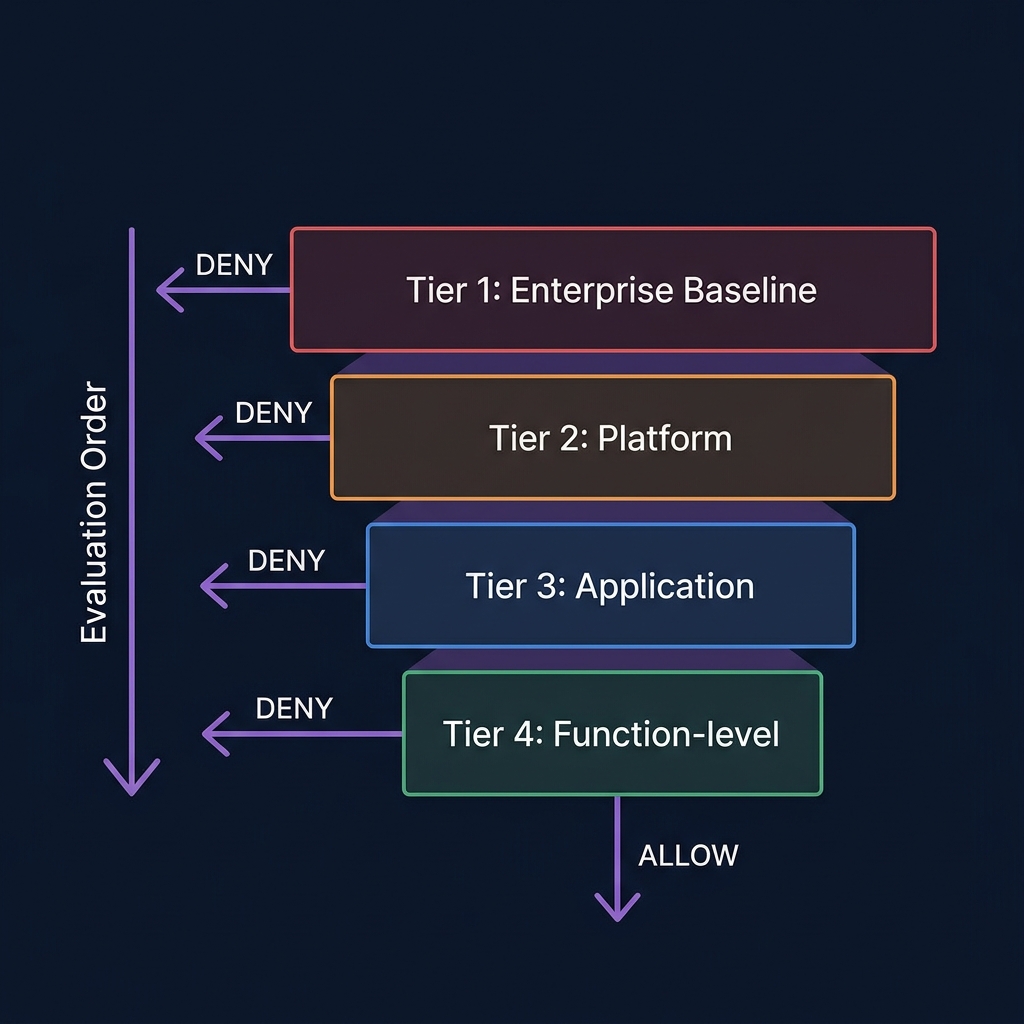
Policies are evaluated in strict descending order. A denial at any tier halts evaluation and blocks execution (Spec §9.6):
| Tier | Scope | Who Controls It | Example |
|---|---|---|---|
| 1. Enterprise Baseline | All invocations globally | Security team (deployment config) | baseline-auth, data-classification |
| 2. Platform | A logical service group | Platform team (deployment config) | payments-pci, hipaa-phi-access |
| 3. Application | A single application | App team (app-level config) | checkout-fraud-check |
| 4. Function-level | One decorated function | Developer (code) | kest/allow_trusted |
Key Invariant: Supplements, Not Replaces
Function-level policies supplement — they never replace — higher-tier policies. A developer cannot bypass an enterprise baseline policy by specifying their own function-level policy. This is enforced architecturally:
@kest_verified(policy="kest/allow_trusted")  # Tier 4 only
def process_order(order_id: str):
    # Enterprise + Platform policies are ALSO evaluated
    # before this function executes
    ...
OPA Integration (Rego)
The OPAPolicyEngine calls a co-located OPA sidecar at localhost:8181:
from kest.core import configure, OPAPolicyEngine

configure(
    engine=OPAPolicyEngine(host="localhost", port=8181),
    enterprise_policies=["baseline-auth", "data-classification"],
)
Rego Policy Example
package kest.allow_trusted

default allow = false

allow {
    input.trust_score >= 50
    not input.subject.taints[_] == "contains_pii"
}
The policy receives the full evaluation context (Spec §9.2):
{
  "subject": {
    "workload": "spiffe://kest.internal/workload/payment-svc",
    "user": "alice",
    "trust_score": 40,
    "taints": ["user_input"]
  },
  "object": {
    "id": "order-12345",
    "attributes": {"amount": 150}
  },
  "environment": {
    "is_root": false,
    "source_type": "user_input",
    "parent_hash": "a1b2c3d4..."
  }
}
Cedar Integration
The CedarPolicyEngine calls a Cedar Agent sidecar at localhost:8180:
from kest.core import configure, CedarPolicyEngine

configure(
    engine=CedarPolicyEngine(host="localhost", port=8180),
)
Cedar Policy Example
permit(
    principal,
    action == Action::"process_payment",
    resource
) when {
    context.trust_score >= 50 &&
    !context.taints.contains("unverified_input")
};
Policy Deviations
Sometimes, a specific function needs to be exempt from a higher-tier policy — for example, a refund flow that doesn't need PCI checks because it operates on already-cleared transactions. Kest supports this through policy deviations (Spec §2.4, F-PE-11):
configure(
    enterprise_policies=["baseline-auth"],
    deviations=[{
        "scope": "process_refund",
        "policy": "payments-pci",
        "tier": "platform",
        "reason": "Refund flow operates on already-cleared transactions",
        "approver": "security-team@example.com"
    }]
)
Critical Safeguards
-
Deviations are configuration, not code — developers cannot self-approve exemptions. Deviations must be declared in deployment configuration.
-
Deviations are signed — every deviation is recorded in the
policy_context.deviationsfield of the signed KestEntry. This makes them cryptographically auditable. -
Deviations don't bypass recording — a deviated invocation still produces a complete, signed entry in the Passport.
-
Empty is normal — most invocations have
deviations: []. The field is always present so audit tools can distinguish "no deviations" from "field absent — possibly tampered."
Evaluation Context
The structured context passed to every policy evaluation (Spec §9.2):
{
  "subject": {
    "workload":    "spiffe://...",
    "user":        "alice",
    "agent":       "web-app",
    "task":        "checkout",
    "trust_score": 40,
    "taints":      ["user_input"]
  },
  "object": {
    "id":         "order-12345",
    "attributes": {"amount": 150, "currency": "USD"}
  },
  "environment": {
    "is_root":           false,
    "source_type":       "user_input",
    "parent_hash":       "a1b2c3d4...",
    "policy_names":      ["kest/allow_trusted"],
    "policy_tier":       "function",
    "active_deviations": []
  }
}
This rich context enables Attribute-Based Access Control (ABAC) — policies can make decisions based on who is calling, what they're accessing, the trust level of the request, and what risk tags (taints) are present.
Logical AND Evaluation
When multiple policies are specified within a tier, all must independently return true (Spec §2.4, F-PE-03):
@kest_verified(policy=["allow_trusted", "check_budget"])
def approve_purchase(amount: float):
    # Both policies must allow — if either denies, execution is blocked
    ...
For the full policy engine interface, see Spec §5.2. For pre-built policies, visit the Policy Library.