
Architecture Overview: Why Kest?
Modern distributed systems are secured at the perimeter — firewalls, API gateways, and static API keys form the first and often the only line of defense. Once an attacker breaches this perimeter or compromises a single key, they move laterally through the network with impunity. Logs can be altered, dropped, or spoofed. Post-breach forensics becomes guesswork.
Kest exists because perimeter security is not enough.
The Gap in Current Zero Trust
Zero Trust architectures (NIST SP 800-207) mandate "never trust, always verify." But most implementations stop at the authentication step — is this caller who they claim to be? They rarely ask the deeper question: what is the full history of this request, and can I cryptographically prove it hasn't been tampered with?
Consider a 3-hop microservice call:
User → API Gateway → Payment Service → Database ServiceTraditional approaches verify identity at each hop independently. But if the Payment Service is compromised, it can:
- Forge its identity in logs
- Claim the request came from a different origin
- Drop inconvenient audit records
- Replay old, legitimate requests to the Database Service
These attacks are invisible to conventional logging because logs are fungible — mutable text files forwarded to a centralized system.
The Kest Approach
Kest combines three pillars into a single, cohesive toolkit:
1. Workload Identity (SPIFFE/SPIRE)
Services do not use static API keys. They receive short-lived, automatically rotated X.509 certificates from SPIRE, where the infrastructure itself attests the workload's identity through kernel-level evidence. No shared secrets ever touch the wire.
Spec Reference: §5.1 IdentityProvider, Principle P1
2. Cryptographic Lineage (Merkle DAG)
Every execution hop produces a KestEntry — a JSON Web Signature (JWS) whose payload is canonicalized per RFC 8785 and whose parent_ids field hashes the preceding JWS. This creates a tamper-evident Merkle chain called the Passport. If any prior entry is altered, every subsequent hash breaks.
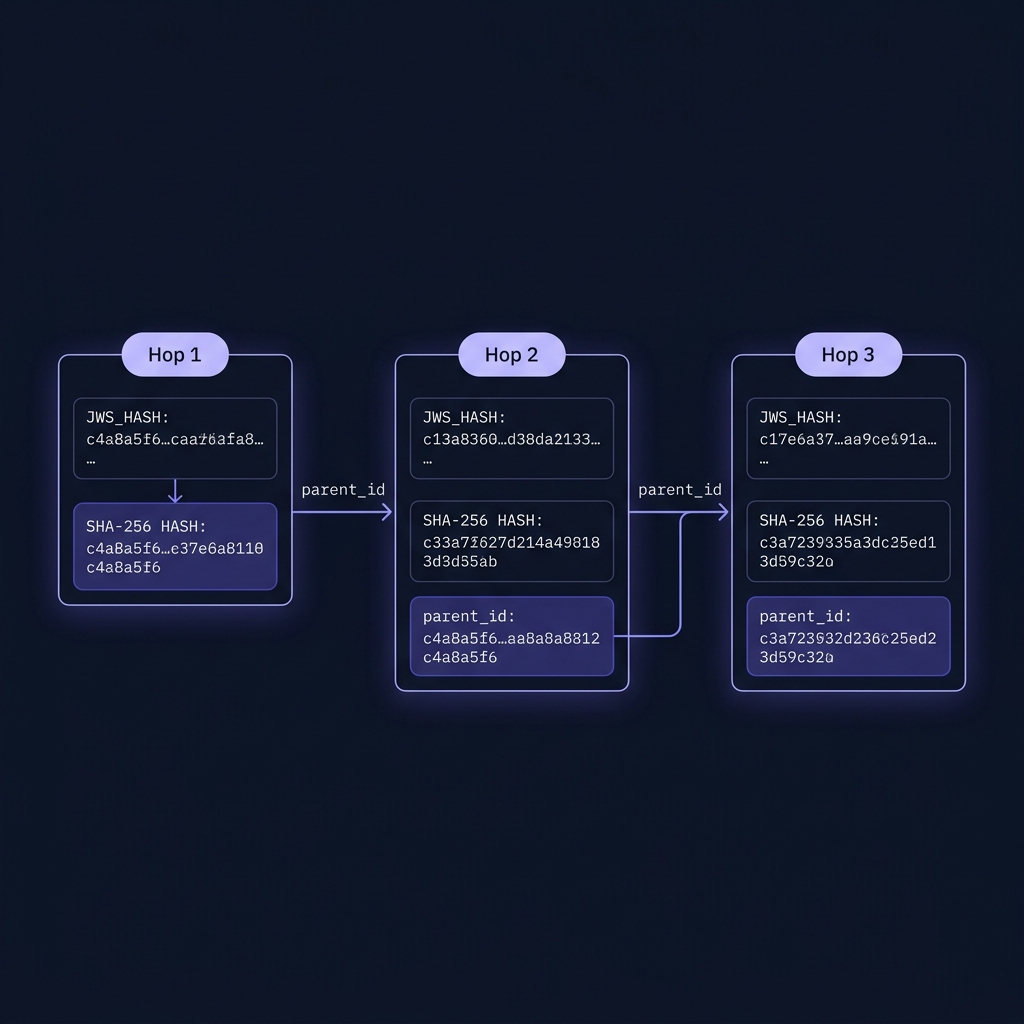
Spec Reference: §4.1 KestEntry, §4.4 Passport, Principle P3
3. Continuous Verification (OPA/Cedar)
At every hop, a co-located policy sidecar evaluates the entire cryptographic lineage — not just the immediate caller. This enables Continuous Adaptive Risk and Trust Assessment (CARTA): trust is a dynamic integer (0–100) that degrades through untrusted hops and can only be restored by explicitly declared, cryptographically signed sanitizers.
Spec Reference: §9 Policy Engine, §7 Trust Model, Principle P2
What You Get
| Capability | Traditional | Kest |
|---|---|---|
| Identity | Static API keys | Ephemeral SPIRE SVIDs |
| Audit | Mutable JSON logs | Merkle-linked JWS signatures |
| Authorization | Per-hop RBAC | Full-lineage ABAC (OPA/Cedar) |
| Trust | Binary (auth/unauth) | Continuous integer 0–100 |
| Tamper detection | None | Cryptographic hash chain |
| Cross-language | Framework-specific | Spec-driven, language-agnostic |
Target Audiences
- Security & Crypto Engineers — dive into the Design Principles and Specification to understand our cryptographic guarantees.
- Platform & Infra Engineers — explore the Developer Guide to deploy SPIRE, configure OPA/Cedar, and manage OTel collectors.
- Application Developers — check out the Getting Started guide to see how simple it is to secure your functions with
@kest_verified.
The full normative specification is available in the Kest v0.3.0 Spec.