
Merkle DAG: Cryptographic Execution Lineage
An action is not trusted merely because the immediate caller is authenticated. Trust requires a cryptographically verified chain of custody covering the entire execution path. This is Kest's second principle (P2), and it is enforced through the Passport — a Merkle-linked graph of signed audit entries.
The Passport Structure
A Passport is an ordered list of JWS (JSON Web Signature) compact strings. Each JWS encodes a KestEntry — the signed audit record for a single execution hop. The entries are cryptographically chained: each entry's parent_ids contains the SHA-256 hashes of the previous JWS strings its execution depended on.
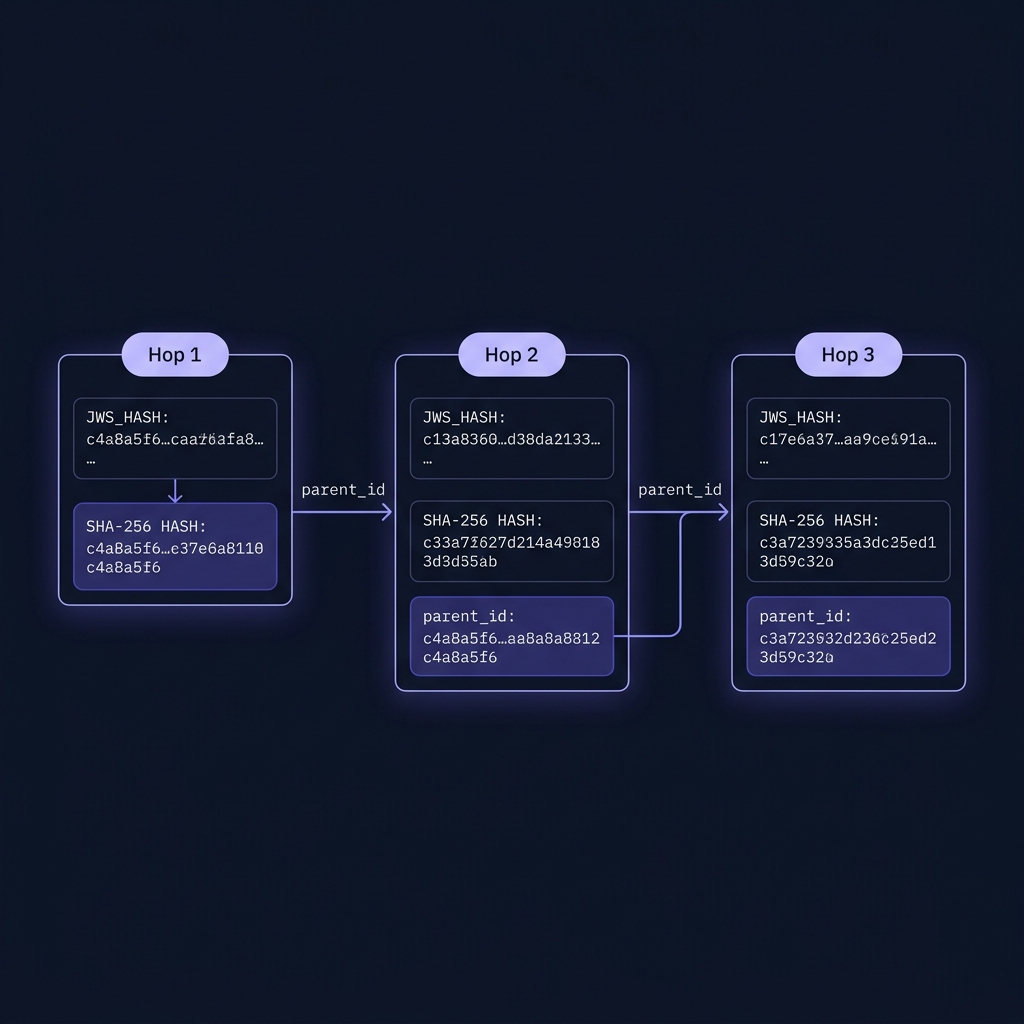
Why a Merkle DAG?
The chaining guarantees three properties:
-
Tamper Evidence — If any past entry is modified (even a single bit), its hash changes, which breaks every subsequent
parent_idslink. A verifier can detect this instantly. -
Non-Repudiation — Each entry is signed by the workload's private key (via JWS/EdDSA). A workload cannot deny having produced an entry.
-
Ordering Guarantee — The hash chain establishes a strict before/after relationship between entries, independent of wall-clock time (which can skew across nodes — see Spec §11.5).
Unlike simple Merkle chains, Kest supports a full Directed Acyclic Graph (DAG). An entry's parent_ids is a list, enabling it to reference multiple prior entries simultaneously. This directly models how real distributed systems behave — parallel branches, convergent flows, and rich dependency graphs.
DAG Topology Scenarios
Kest natively supports six execution topologies. Each is cryptographically verified as part of the standard PassportVerifier.verify() pass.
1. Linear (Standard Chain)
The simplest case. Each step has exactly one parent.
# parent_ids with a single predecessor
entry_c = KestEntry(parent_ids=[hash_of_b], ...)
2. Fan-Out
One parent spawns multiple independent branches. Each branch creates its own sub-chain from the parent tip. Branch contexts are isolated — mutations in Branch A do not affect Branch B (see §11.7).
Fan-Out is implicit in Kest: when multiple tasks inherit the same OTel context, each creates its own independent entry with the same parent hash.
3. Fan-In
Multiple independent lineages converge into a single node. The convergence point is declared via Passport.merge() before the merger entry is created.
from kest.core import Passport

# Combine two independent lineages
merged = Passport.merge(passport_a, passport_b)

# The next @kest_verified call will reference tip(A) and tip(B) as parents
Passport.merge() deduplicates entries and preserves topological order. The resulting passport is ready for a downstream step that depends on both branches.
4. Diamond
The most common real-world DAG pattern. A root fans out into parallel branches, which then fan back in. The final merger declares both branch tips as parents.
# Diamond: A → B, A → C, {B,C} → D
entry_d = KestEntry(parent_ids=[hash_of_b, hash_of_c], ...)
5. Skip Connection
An entry that depends on both an immediate parent and a more distant ancestor. This is useful for workflows where a downstream step needs to directly reference a root guarantee, bypassing intermediate hops.
# C depends on both A and B directly
entry_c = KestEntry(parent_ids=[hash_of_b, hash_of_a], ...)
6. Multi-Root
Multiple independent source entries with no common ancestor. This models fully independent parallel workloads that eventually converge.
How Entries Are Created
When @kest_verified executes, the Verification Hook (Spec §5.8) performs these steps:
# Step 1: Extract the current Passport from OTel context
passport = get_current_passport()  # may be empty for root

# Step 2: Compute parent_ids from all active chain tips
active_tips = get_active_tips()  # comma-separated from kest.chain_tip baggage
if active_tips:
    parent_ids = [sha256(tip_jws).hexdigest() for tip_jws in active_tips]
else:
    parent_ids = ["0"]  # sentinel for chain root

# Step 3: Build the KestEntry payload
payload = {
    "entry_id": uuid7(),           # RFC 9562 time-ordered UUID
    "operation": "process_payment",
    "trust_score": 40,
    "parent_ids": parent_ids,      # list — supports multi-parent DAG nodes
    "taints": ["user_input"],
    "labels": {
        "principal": "spiffe://kest.internal/workload/payment-svc",
        "trace_id": "4bf92f3577b34da6a3ce929d0e0e4736"
    },
    # ... remaining fields per §4.1
}

# Step 4: Canonicalize (RFC 8785) and sign (EdDSA/JWS)
canonical_bytes = jcs_canonicalize(payload)
jws = identity.sign(canonical_bytes)  # → "header.payload.signature"

# Step 5: Append to Passport
passport.add_signature(jws)
The JWS Format
Every entry is serialized as a JWS compact string with three dot-separated, base64url-encoded segments:
eyJhbGciOiJFZERTQSIsInR5cCI6IkpXUyJ9.eyJlbnRyeV9pZCI6Ii4uLiJ9.signature
│────────── header ──────────│──── payload ────│─ signature ─│- Header:
{"alg":"EdDSA","typ":"JWS"}— always Ed25519 - Payload: RFC 8785-canonicalized KestEntry JSON
- Signature: Ed25519 signature of
base64url(header).base64url(payload)
RFC 8785: Why Canonicalization Matters
JSON objects are unordered by specification. {"a":1,"b":2} and {"b":2,"a":1} are semantically identical but produce different byte strings — and therefore different signatures. RFC 8785 (JSON Canonicalization Scheme) mandates:
- Keys sorted lexicographically by Unicode code points
- No whitespace outside strings
- Numbers in shortest round-trip representation
This ensures byte-identical output across all conformant implementations, which is the foundation of polyglot interoperability (Principle P6).
Verification
The PassportVerifier validates an entire Passport in a single pass (Spec §6.2). It supports all DAG topologies using a set-based seen-hash approach:
from kest.core import Passport, PassportVerifier

passport = Passport.deserialize(serialized_data)
PassportVerifier.verify(passport, providers={
    "spiffe://kest.internal/workload/api-gw": api_gw_provider,
    "spiffe://kest.internal/workload/payment-svc": payment_provider,
})
The algorithm:
- Initialize
seen_hashes = {"0"}(the sentinel root is always valid) - For each JWS in the passport (in topological order):
- Parse the payload
- Assert all
parent_idsare present inseen_hashes - Verify the JWS signature against the workload's public key
- Compute
sha256(jws)and add it toseen_hashes
- If all checks pass, the entire DAG is cryptographically proven unaltered
Topological Contract: Passport entries MUST be ordered such that every parent appears before its child.
Passport.merge()guarantees this automatically.
What Breaks the Chain
| Attack | Detection |
|---|---|
| Modify a past entry's payload | SHA-256 hash mismatch — orphaned parent_ids reference |
| Delete an entry from the middle | parent_ids reference not found in seen_hashes |
| Reorder entries | Parent not yet seen when child is processed |
| Forge a new entry | JWS signature verification failure (wrong private key) |
| Replay an old Passport | Entry timestamps and UUIDs won't match expected context |
| Inject a false merge node | parent_ids references unknown hashes |
Combining Lineages with Passport.merge()
When parallel branches need to converge, use Passport.merge():
from kest.core import Passport

# branch_a.entries = [sig_root, sig_branch_a]
# branch_b.entries = [sig_root, sig_branch_b]

merged = Passport.merge(branch_a, branch_b)
# merged.entries = [sig_root, sig_branch_a, sig_branch_b]
# → Deduplicated (sig_root appears once) and topologically ordered
Passport.merge() guarantees:
- No duplicates — entries that appear in multiple passports are included only once
- Insertion order preserved — earlier entries (by original position) retain their relative order
- Valid for verification —
PassportVerifier.verify()can process the result directly
Propagation Across Services
The Passport travels with the request via W3C Baggage HTTP headers (Spec §8). The active chain tip (or tips for multi-parent merges) is tracked separately:
baggage: kest.passport=["header.payload.sig1","header.payload.sig2"],kest.chain_tip=<hash1>,<hash2>For Fan-In scenarios, kest.chain_tip carries a comma-separated list of parent hashes:
baggage: kest.chain_tip=sha256(branch_a_jws),sha256(branch_b_jws)When the serialized Passport exceeds 4KB, the Claim Check pattern kicks in — the full Passport is stored in a CacheProvider and only a UUID reference travels in the header.
For the full data model, see Audit Entry. For the normative algorithm, see Spec §6.2. For DAG edge case handling, see Edge Cases §11.8.