
Scope-Delegated Gateway: Full Zero Trust Delegation
A step-by-step walkthrough of the most complete Zero Trust delegation flow Kest supports: human → agent → gateway → task, with token contents, policy context, and signed audit entries shown at every hop.
This walkthrough demonstrates the most complete delegation flow Kest supports:
- A human user (Alice) authenticates via Keycloak and delegates to an AI agent.
- The agent performs an RFC 8693 On-Behalf-Of (OBO) exchange and presents the token to a gateway.
- The gateway enforces scope policy, mints a narrow-scope task token, and calls downstream services.
- Every hop produces a signed
KestEntrychained into a tamper-evident Merkle DAG.
At the end of this page you will see the actual token payloads, policy context dictionaries, and signed audit entries at each step.
Try it yourself: Ships in the kest-lab showcase. Run
moon run kest-lab:upthenmoon run kest-lab:test-live -k test_gateway.
Architecture Overview
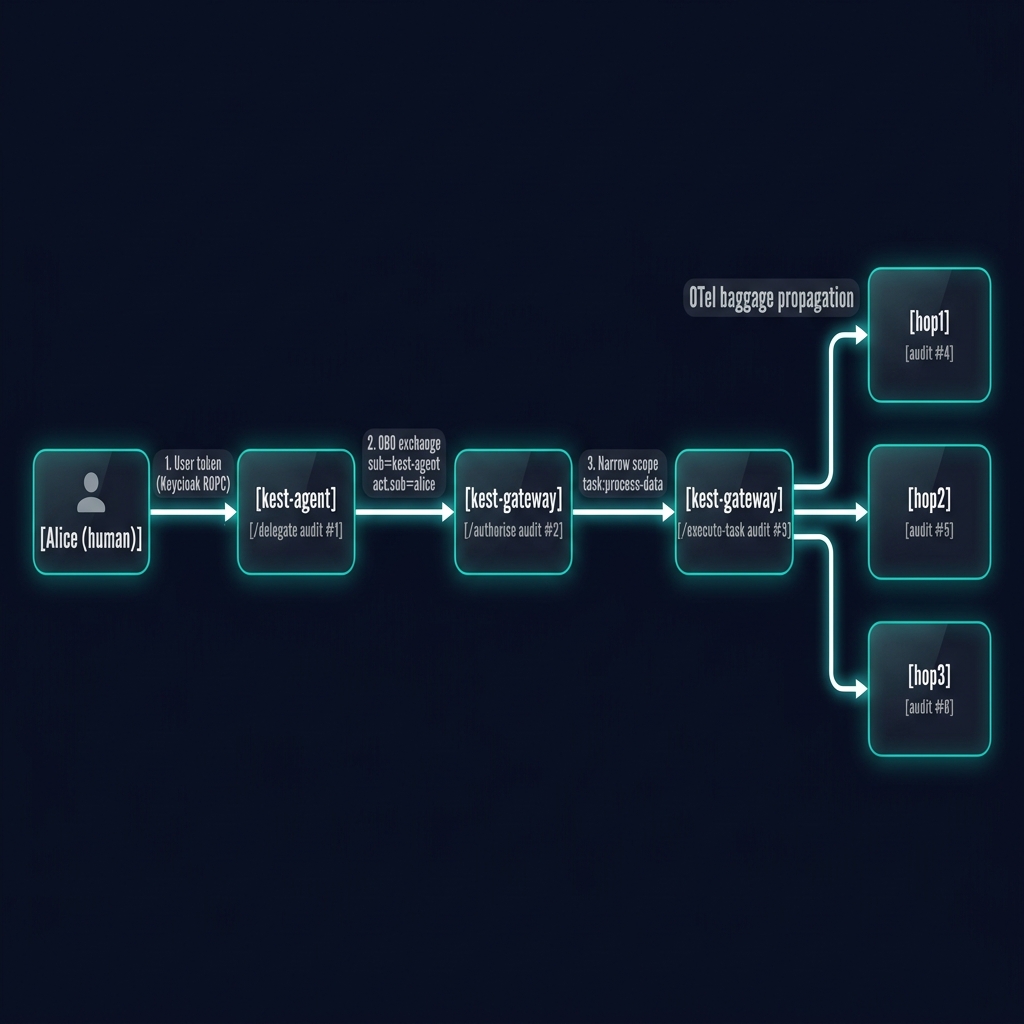
Six signed KestEntry records are chained into one Merkle DAG:
| # | Service | Operation | Policy Enforced | Signer Identity |
|---|---|---|---|---|
| 1 | kest-agent | /delegate-to-gateway | delegation_policy | alice + kest-agent |
| 2 | kest-gateway | /authorise | gateway_policy (scope check) | kest-agent + alice |
| 3 | kest-gateway | /execute-task | task_policy (narrow scope) | kest-gateway |
| 4 | hop1 | GET / | workload_user_policy | kest-gateway |
| 5 | hop2 | GET /hop2 | workload_user_policy | kest-gateway |
| 6 | hop3 | GET /hop3 | workload_user_policy | kest-gateway |
Step 1 — Alice Authenticates (Keycloak ROPC)
Alice uses a Resource Owner Password Credentials (ROPC) grant to obtain a Keycloak token, requesting the optional data scopes she needs to delegate:
POST /realms/kest-lab/protocol/openid-connect/token
Content-Type: application/x-www-form-urlencoded

grant_type=password&client_id=kest-cli&username=alice&password=alice
&scope=openid+profile+roles+read:data+write:data
Resulting JWT payload (Alice's token):
{
  "sub": "a1b2c3d4-0001-0001-0001-000000000001",
  "preferred_username": "alice",
  "realm_access": { "roles": ["kest-reader"] },
  "scope": "openid profile roles read:data write:data",
  "aud": ["account"],
  "exp": 1775491200
}
Security note: Alice's token is presented only to kest-agent and never forwarded directly to downstream services.
Step 2 — OBO Exchange & Agent Delegation (Audit #1)
kest-agent receives Alice's token and exchanges it for an On-Behalf-Of (OBO) token via Keycloak's token exchange endpoint (RFC 8693). The new token's sub becomes kest-agent while Alice's identity is preserved in the act claim.
OBO Token payload:
{
  "sub": "kest-agent",
  "act": { "sub": "a1b2c3d4-0001-0001-0001-000000000001" },
  "scope": "openid profile roles read:data write:data",
  "aud": ["kest-gateway"],
  "exp": 1775491200
}
kest-agent's @kest_verified produces Audit Entry #1:
@kest_verified(
    policy="delegation_policy",
    origin="internet",          # trust bootstrapped at 10
)
async def _delegate_logic():
    ...
Context passed to delegation_policy (Cedar):
{
    "principal": "spiffe://kest.internal/workload/kest-agent",
    "trust_score": 10,          # ORIGIN_TRUST_MAP["internet"] = 10
    "is_root": True,            # first hop in the chain
    "chain_tip": "0",
    "principal_user": "a1b2c3d4-0001-0001-0001-000000000001",
    "principal_agent": "kest-agent",
    "principal_scope": "openid profile roles read:data write:data",
}
Signed KestEntry #1 payload (decoded from JWS):
{
  "entry_id": "11111111-aaaa-bbbb-cccc-000000000001",
  "operation": "_delegate_logic",
  "classification": "system",
  "trust_score": 10,
  "parent_ids": ["0"],
  "added_taints": [],
  "removed_taints": [],
  "taints": [],
  "labels": {
    "principal": "spiffe://kest.internal/workload/kest-agent",
    "kest.identity": "{\"user\": \"a1b2c3d4-...\", \"agent\": \"kest-agent\"}",
    "trace_id": "d449a53efe8b1cd431d84db00f8dc43a"
  },
  "timestamp_ms": 1775494707000
}
The SHA-256 of this JWS becomes chain_tip and is injected into outgoing OTel baggage headers as kest.chain_tip.
Step 3 — Gateway /authorise (Audit #2)
kest-agent forwards the OBO token to kest-gateway POST /authorise. The KestIdentityMiddleware on the gateway parses the JWT and injects four OTel baggage keys:
| OTel Baggage Key | Value | Source |
|---|---|---|
kest.principal_user | a1b2c3d4-... (alice's UUID) | act.sub from OBO token |
kest.principal_agent | kest-agent | azp / sub from OBO token |
kest.principal_scope | openid profile roles read:data write:data | scope from OBO token |
kest.chain_tip | SHA-256 of entry #1 | Propagated baggage from kest-agent |
The @kest_verified decorator on _authorise_logic now runs:
@kest_verified(
    policy="gateway_policy",
    origin="internal",          # trust_score = 100
)
async def _authorise_logic():
    ...
Context passed to gateway_policy (CedarLocalEngine):
{
    "principal": "spiffe://kest.internal/workload/kest-gateway",
    "trust_score": 100,         # ORIGIN_TRUST_MAP["internal"] = 100
    "is_root": False,
    "chain_tip": "31a2f9...",   # SHA-256 of entry #1
    "principal_user": "a1b2c3d4-0001-0001-0001-000000000001",
    "principal_agent": "kest-agent",
    "principal_scope": "openid profile roles read:data write:data",
}
gateway_policy.cedar evaluation:
permit(principal, action, resource) when {
    context["trust_score"] >= 10 &&               // 100 >= 10 ✓
    context has "principal_user" &&
    context["principal_user"] != "" &&             // alice UUID ✓
    context has "principal_agent" &&
    context["principal_agent"] != "" &&            // "kest-agent" ✓
    context has "principal_scope" &&
    context["principal_scope"] like "*read:data*"  // scope contains "read:data" ✓
};
// → Allow
Signed KestEntry #2 payload:
{
  "entry_id": "22222222-aaaa-bbbb-cccc-000000000002",
  "operation": "_authorise_logic",
  "classification": "system",
  "trust_score": 100,
  "parent_ids": ["31a2f90fb8aeda526638948834a5fd5..."],
  "added_taints": [],
  "removed_taints": [],
  "taints": [],
  "labels": {
    "principal": "spiffe://kest.internal/workload/kest-gateway",
    "kest.identity": "{\"user\": \"a1b2c3d4-...\", \"agent\": \"kest-agent\"}",
    "trace_id": "d449a53efe8b1cd431d84db00f8dc43a"
  },
  "timestamp_ms": 1775494708000
}
Step 4 — Task Token Minted
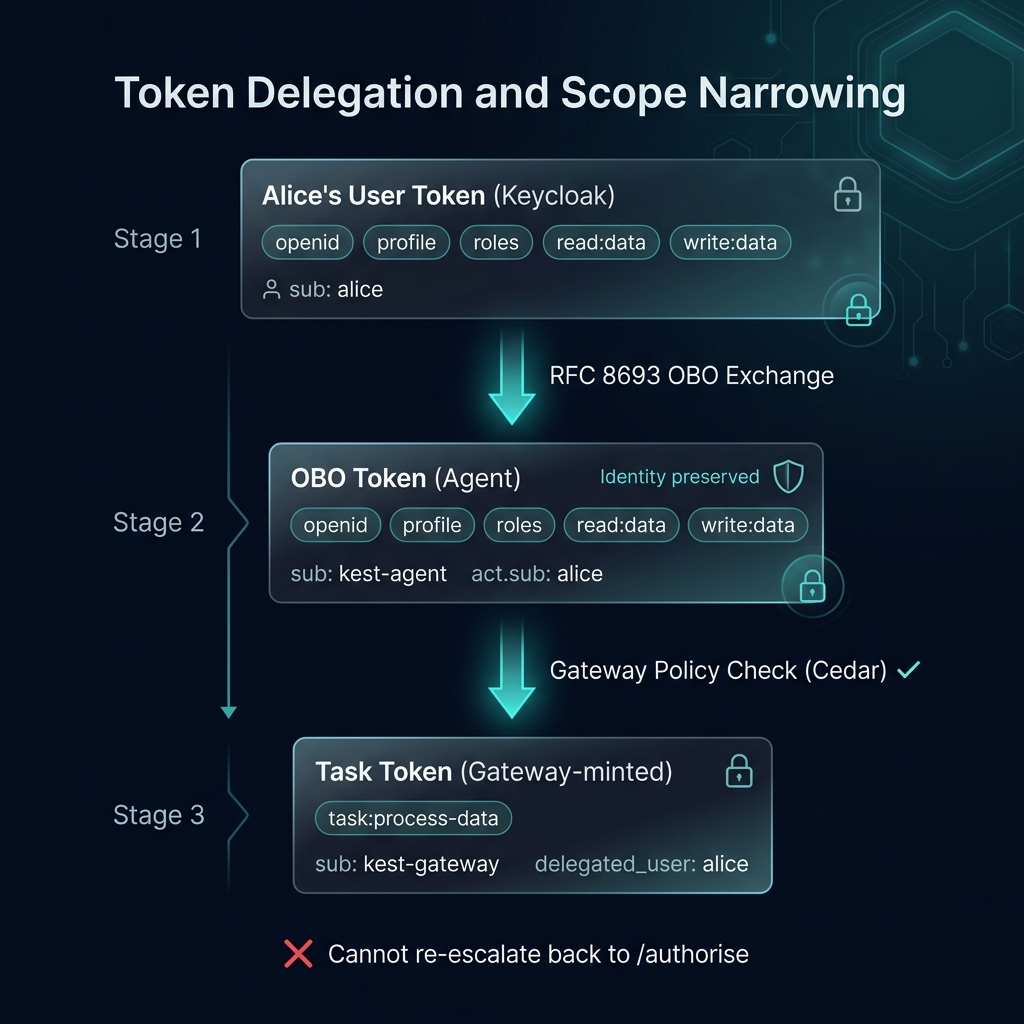
After policy passes, the gateway mints a narrow-scope task token using its own LocalEd25519Provider (or SPIREProvider in production). This token carries only the scope required for the specific task — not Alice's full delegated scopes.
Task token JWT payload:
{
  "iss": "kest-gateway/kest-gateway",
  "sub": "kest-gateway",
  "iat": 1775494708,
  "exp": 1775495008,
  "scope": "task:process-data",
  "task": "process-data",
  "delegated_user": "a1b2c3d4-0001-0001-0001-000000000001",
  "delegated_agent": "kest-agent"
}
Scope narrowing: Alice's token had
read:data write:data. The task token carries onlytask:process-data. The agent cannot re-use this token to obtain a second delegation (Flow F in the test suite enforces this as a 403).
Step 5 — Gateway /execute-task (Audit #3)
kest-agent posts the task token back to kest-gateway POST /execute-task. The gateway decodes the task token and injects its scope into baggage before invoking the @kest_verified decorator:
ctx = otel_baggage.set_baggage("kest.principal_scope", "task:process-data")
ctx = otel_baggage.set_baggage("kest.principal_user", delegated_user)
ctx = otel_baggage.set_baggage("kest.principal_agent", delegated_agent)
Context passed to task_policy (CedarLocalEngine):
{
    "principal": "spiffe://kest.internal/workload/kest-gateway",
    "trust_score": 100,         # ORIGIN_TRUST_MAP["internal"] = 100
    "is_root": False,
    "chain_tip": "c82664...",   # SHA-256 of entry #2
    "principal_user": "a1b2c3d4-0001-0001-0001-000000000001",
    "principal_agent": "kest-agent",
    "principal_scope": "task:process-data",
}
task_policy.cedar evaluation:
permit(principal, action, resource) when {
    context["trust_score"] >= 50 &&                              // 100 >= 50 ✓
    context has "principal_scope" &&
    context["principal_scope"] == "task:process-data"            // exact match ✓
};
// → Allow
Signed KestEntry #3 payload:
{
  "entry_id": "33333333-aaaa-bbbb-cccc-000000000003",
  "operation": "_execute_task_logic",
  "classification": "system",
  "trust_score": 100,
  "parent_ids": ["c82664a3cf66be1310319801ff96e64c..."],
  "added_taints": [],
  "removed_taints": [],
  "taints": [],
  "labels": {
    "principal": "spiffe://kest.internal/workload/kest-gateway",
    "kest.identity": "{\"user\": \"a1b2c3d4-...\", \"agent\": \"kest-agent\"}",
    "trace_id": "d449a53efe8b1cd431d84db00f8dc43a"
  },
  "timestamp_ms": 1775494709000
}
The gateway now calls hop1 with the OTel baggage propagated (including kest.chain_tip and kest.passport).
Step 6 — hop1 → hop2 → hop3 (Audits #4–#6)
Each hop service runs KestMiddleware (which extracts the incoming Passport from baggage) and a @kest_verified-decorated handler. The workload_user_policy at each hop verifies the trust score and that the scope is still task:process-data.
OTel baggage propagated between hops:
baggage: kest.chain_tip=<sha256 of prev entry>,
         kest.passport=["<jws1>","<jws2>","<jws3>"],
         kest.principal_scope=task:process-data,
         kest.principal_user=a1b2c3d4-...,
         kest.principal_agent=kest-agent
Context passed to workload_user_policy at hop1:
{
    "principal": "spiffe://kest.internal/workload/hop1",
    "trust_score": 100,         # inherited from parent (100 * 100 / 100 = 100)
    "is_root": False,
    "chain_tip": "<sha256 of entry #3>",
    "principal_user": "a1b2c3d4-0001-0001-0001-000000000001",
    "principal_agent": "kest-agent",
    "principal_scope": "task:process-data",
}
Signed KestEntry #4 payload (hop1):
{
  "entry_id": "44444444-aaaa-bbbb-cccc-000000000004",
  "operation": "get_data",
  "classification": "system",
  "trust_score": 100,
  "parent_ids": ["<sha256 of entry #3>"],
  "added_taints": [],
  "removed_taints": [],
  "taints": [],
  "labels": {
    "principal": "spiffe://kest.internal/workload/hop1",
    "kest.identity": "{\"user\": \"a1b2c3d4-...\", \"agent\": \"kest-agent\"}",
    "trace_id": "d449a53efe8b1cd431d84db00f8dc43a"
  },
  "timestamp_ms": 1775494710000
}
hop2 and hop3 produce identical structure, each extending the chain via their parent_ids.
The Final Passport
After the full flow, the kest.passport baggage header carries all 6 JWS entries as a JSON array. Each entry's parent_ids[0] is the SHA-256 of the preceding signature — forming a cryptographically linked Merkle chain.
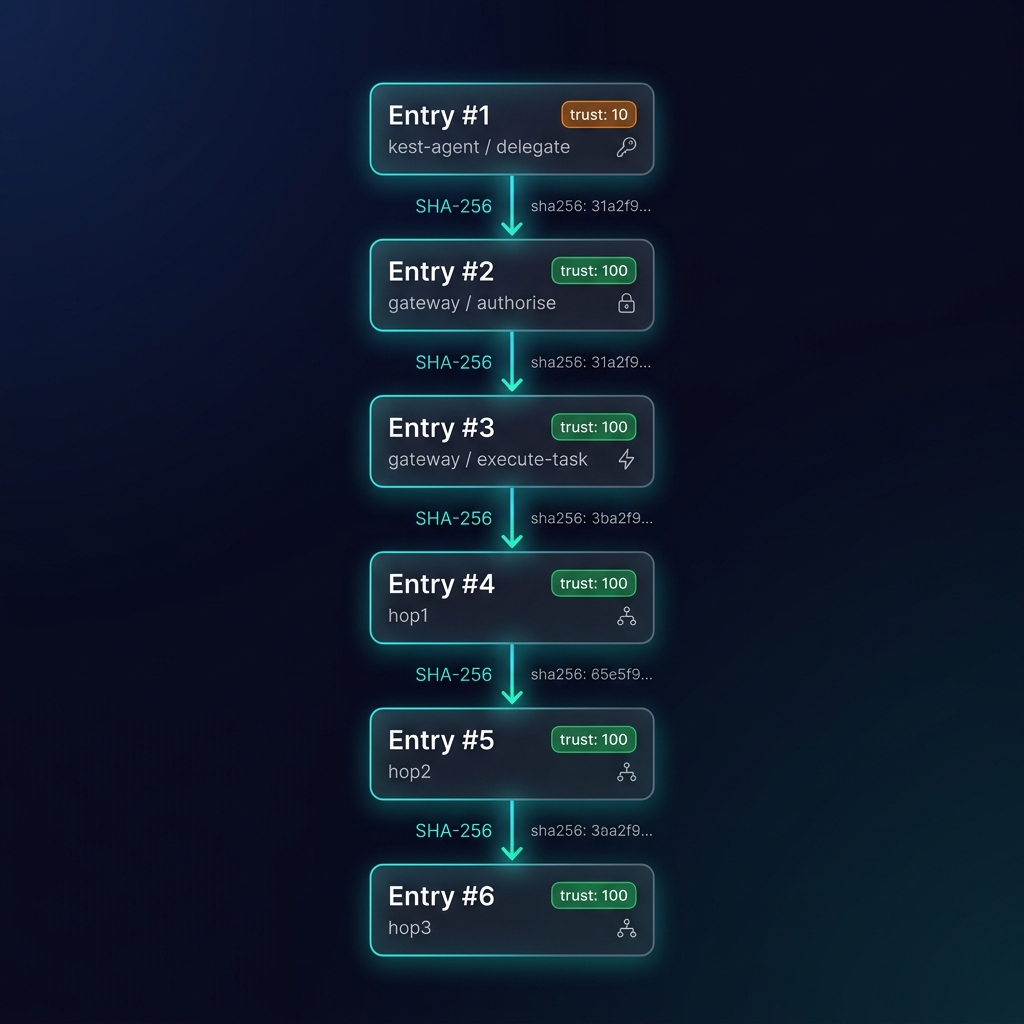
To verify this chain programmatically:
from kest.core import Passport, PassportVerifier

passport = Passport.deserialize(baggage_passport_json)
PassportVerifier.verify(passport, providers={
    "spiffe://kest.internal/workload/kest-agent": agent_identity,
    "spiffe://kest.internal/workload/kest-gateway": gateway_identity,
    "spiffe://kest.internal/workload/hop1": hop1_identity,
    # ...
})
Trust Score Propagation
Note that trust_score in entry #1 is 10 (bootstrapped from ORIGIN_TRUST_MAP["internet"]). Entry #2 onward uses ORIGIN_TRUST_MAP["internal"] = 100 because the gateway re-bootstraps trust at the internal boundary.
The DefaultTrustEvaluator applies: score = (min(parent_scores) * self_score) // 100.
For entries #2–#6 (all internal origin, self_score=100, parent from a non-root hop=100):
min(100) * 100 // 100 = 100This is why the task execution chain sees a full trust score of 100, even though the delegation entry started at 10.
What Happens When Policy Fails?
Flow E — Insufficient scope (403)
If Alice's token lacks read:data, gateway_policy denies the request:
# KestIdentityMiddleware extracts: principal_scope = "openid profile roles"
{
    "principal_scope": "openid profile roles",  # no "read:data"
    ...
}
# gateway_policy: context["principal_scope"] like "*read:data*" → false
# @kest_verified raises PermissionError
# → gateway exception_handler returns HTTP 403
Flow F — Task token cannot re-delegate (403)
A task token presented back to /authorise is denied because:
# principal_scope = "task:process-data" (does not contain "read:data")
# gateway_policy forbids this → 403
This enforces the one-way scope narrowing: task tokens cannot escalate back to delegation tokens.
Cedar Policies
gateway_policy.cedar
// gateway_policy.cedar
// Evaluated by CedarLocalEngine on kest-gateway /authorise.
// Permits delegation if: user present, agent present, scope contains read:data, trust >= 10.

permit(principal, action, resource) when {
    context["trust_score"] >= 10 &&
    context has "principal_user" &&
    context["principal_user"] != "" &&
    context has "principal_agent" &&
    context["principal_agent"] != "" &&
    context has "principal_scope" &&
    context["principal_scope"] like "*read:data*"
};
task_policy.cedar
// task_policy.cedar
// Evaluated by CedarLocalEngine on kest-gateway /execute-task.
// Permits execution only with the exact narrow task scope and internal trust level.

permit(principal, action, resource) when {
    context["trust_score"] >= 50 &&
    context has "principal_scope" &&
    context["principal_scope"] == "task:process-data"
};
Security Analysis: What If kest-gateway Is Compromised?
Under the self-signing approach (Approach A):
- Detection: Every task token use produces a signed
KestEntry. A Merkle DAG analysis can flag entries where kest-gateway appears as signer without a validuser→agentparent delegation in the same Passport. - Containment: Rotate the gateway's signing key. If using
SPIREProvider, revoke the SVID — all tokens signed by the old key become cryptographically unverifiable. - Prevention: Back kest-gateway with SPIRE. A compromised pod that restarts fails re-attestation if its attributes change.
Source Files
| File | Description |
|---|---|
gateway.py | kest-gateway FastAPI service |
agent.py | kest-agent (includes /delegate-to-gateway) |
cedar/policies/gateway_policy.cedar | Scope enforcement policy |
cedar/policies/task_policy.cedar | Task token enforcement policy |
cedar/policies/delegation_policy.cedar | Agent delegation policy |
cedar/policies/workload_user_policy.cedar | Hop-to-hop service policy |
tests/test_gateway_e2e.py | Full E2E test suite (4 flows) |