
Kest provides a comprehensive testing strategy spanning unit tests with mocks to fully orchestrated integration tests in a Docker-based lab environment. This section describes the philosophy, tools, and how to run the full verification suite.
Testing Philosophy
- Tests MUST be written before code — Test-Driven Development (TDD) is mandatory (Principle from AGENTS.md)
- Unit tests are co-located — alongside source files with
_test.pysuffix - Mocking is only for external boundaries — mock the policy engine and identity provider, not internal logic
- Integration tests use real infrastructure — SPIRE, OPA, Cedar, Keycloak — not simulated
Unit Testing with Mocks
Kest provides two mock implementations specifically designed for testing:
MockPolicyEngine
from kest.core import MockPolicyEngine

# Always allow — for testing business logic
engine = MockPolicyEngine(allow=True)

# Always deny — for testing error paths
engine = MockPolicyEngine(allow=False)

# Custom logic — for complex test scenarios
engine = MockPolicyEngine(
    allow=lambda context: context["subject"]["trust_score"] >= 50
)
MockIdentityProvider
from kest.core import MockIdentityProvider

# Deterministic signing with HMAC-SHA256
identity = MockIdentityProvider(workload_id="test-service")
The mock uses HMAC-SHA256 with a fixed key ("mock-key") for deterministic, reproducible signatures. This makes assertions on JWS content possible in tests.
Example Unit Test
import pytest
from kest.core import configure, kest_verified, MockPolicyEngine

@pytest.fixture(autouse=True)
def setup_kest():
    """Reset Kest state between tests."""
    from kest.core import invalidate_policy_cache
    invalidate_policy_cache()   # flush policy decision cache
    configure(
        engine=MockPolicyEngine(allow=True),
    )
    yield
    invalidate_policy_cache()

def test_process_payment_success():
    @kest_verified(policy="kest/allow_trusted", source_type="internal")
    def process_payment(amount: float) -> dict:
        return {"status": "completed", "amount": amount}

    result = process_payment(99.95)
    assert result["status"] == "completed"
    assert result["amount"] == 99.95

def test_process_payment_denied():
    configure(engine=MockPolicyEngine(allow=False))

    @kest_verified(policy="kest/allow_trusted", source_type="internal")
    def process_payment(amount: float) -> dict:
        return {"status": "completed"}

    with pytest.raises(Exception):
        process_payment(99.95)
Running Unit Tests
# Via moonrepo
moon run kest-core-python:test

# Or directly with pytest
cd libs/kest-core/python
uv run pytest python/kest/core/ -v
Kest Lab: Integration Testing
The kest-lab is a Docker Compose environment that spins up real infrastructure for end-to-end testing. It validates that Kest works correctly with real identity providers, real policy engines, and real telemetry collectors.
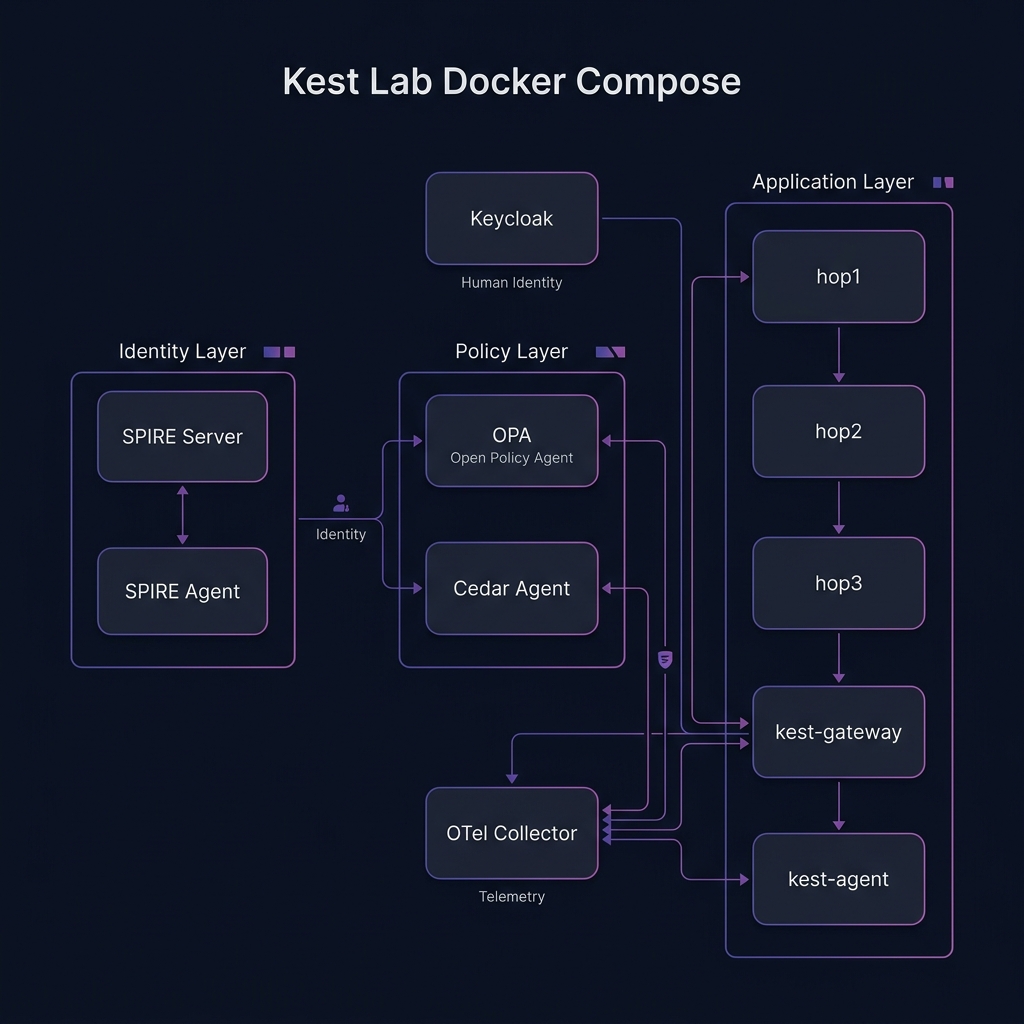
Lab Architecture
The lab includes these services:
| Service | Purpose | Port |
|---|---|---|
spire-server | SPIFFE identity root of trust | — |
spire-agent | Workload attestation agent | Unix socket |
opa | Open Policy Agent sidecar | 8181 |
cedar-agent | Cedar policy sidecar | 8180 |
keycloak | Human identity provider (OIDC) | 8080 |
otel-collector | Telemetry aggregation | 4317 (gRPC) |
hop1, hop2, hop3 | Application nodes for chain testing | — |
kest-gateway | Scope-delegated gateway | 8000 |
kest-agent | AI agent simulation | 8001 |
Running the Lab
# Start the lab (auto-creates containers)
moon run kest-lab:up

# Run all integration tests inside the hop1 container
moon run kest-core-python:test-live

# Tear down
moon run kest-lab:down
Why inside the container? Tests run inside
hop1because SPIRE requires PID namespace attestation. The test process must be running in the same PID namespace as the SPIRE Agent. On Docker Desktop (especially WSL2), this means running inside the container, not from the host.
Test Categories (17 Integration Tests)
The lab validates 5 categories:
1. Basic Lifecycle (5 tests)
- Root entry creation with
parent_ids: ["0"] - 2-hop chain with correct parent hash linkage
- 3-hop chain with full Merkle verification
- Taint propagation through the chain
- Trust score degradation at each hop
2. Security Enforcement (4 tests)
- Signature verification on the complete chain
- Security halt on tampered Passport (HMAC mismatch)
- Policy denial blocks function execution
- Empty policy list rejected at config time
3. Trust & Taints (3 tests)
- Custom source types via
register_origin_trust() - Taint sanitization with
removed_taints - Trust override with
trust_override
4. Policy Hierarchy (3 tests)
- Enterprise baseline evaluated first
- Function-level supplements (doesn't replace) enterprise
- Policy deviations recorded in signed entry
5. Identity Context (2 tests)
- User/agent/task recorded in
labels.kest.identity - Resource attributes in
labels.kest.resource_attr
Example Integration Test
@pytest.mark.live
async def test_3hop_chain():
    """Validate a full 3-hop Merkle chain."""
    configure(engine=MockPolicyEngine(allow=True), clear=True)

    @kest_verified(policy="allow", source_type="system")
    def hop1():
        return hop2()

    @kest_verified(policy="allow", source_type="internal")
    def hop2():
        return hop3()

    @kest_verified(policy="allow", source_type="user_input")
    def hop3():
        return "final"

    result = hop1()
    assert result == "final"

    # Verify the chain
    passport = get_current_passport()
    assert len(passport.entries) == 3

    # Verify hash linkage
    for i in range(1, len(passport.entries)):
        prev_hash = sha256(passport.entries[i-1].encode()).hexdigest()
        entry = decode_jws_payload(passport.entries[i])
        assert entry["parent_ids"][0] == prev_hash
Full Verification Workflow
Before any code changes are committed, both test levels MUST pass:
# Run everything — unit tests + live integration tests
# Using the @verify workflow:
moon run kest-core-python:test && moon run kest-core-python:test-live
Current suite health:
- 136/136 unit tests passing (124 original + 12 security hardening)
- 17/17 integration tests passing
Security and Hardening Tests
The 2026-04-11 security hardening added 12 targeted unit tests across three files:
| File | Tests | Covers |
|---|---|---|
policy_decision_cache_test.py | 5 | B-01: cache key isolation by user/agent/task, TTL=0, invalidation |
decorators_baggage_test.py | 4 | R-02: baggage reads from OTel context only, no global dict coupling |
ext_test.py | 3 | D-01: spec-compliant baggage key names; R-03: JWT verification guard |
Key patterns (see LEARNINGS.md §10 — T-09):
- When testing
KestIdentityMiddleware, theappargument must be a genuineasync defcoroutine (not aMock()) so that baggage reads from the OTel context propagate correctly. - Call
invalidate_policy_cache()in every test fixture — cached decisions from one test leak across process-shared sessions.
For a deep dive into the lab architecture, see Kest Lab Deep Dive. For the full spec on edge-case testing, see Spec §11.