
Kest implements Continuous Adaptive Risk and Trust Assessment (CARTA) — a model where trust is not a static binary (authenticated/unauthenticated) but a dynamic integer that flows through the execution graph, degrading through untrusted nodes and increasing only through explicit sanitization.
Trust Scores (0–100)
Trust is represented as an integer from 0 (completely untrusted) to 100 (maximum trust). The score quantifies confidence in the provenance of the execution chain.
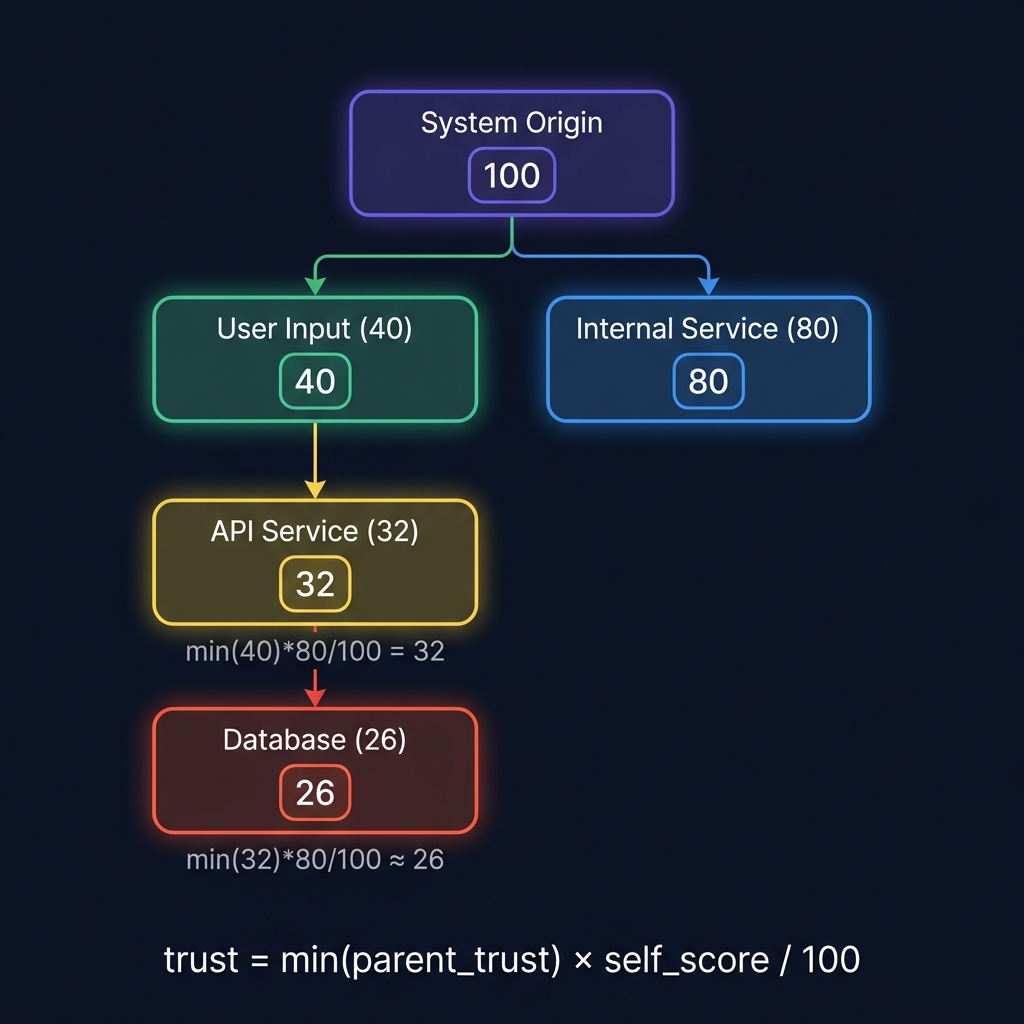
The ORIGIN_TRUST_MAP
Every data source has a default trust score defined in the ORIGIN_TRUST_MAP (Spec §7.1):
| Source Type | Trust Score | Rationale |
|---|---|---|
system | 100 | Machine-generated, no human input |
internal | 80 | Internal API, behind perimeter |
verified_partner | 70 | Contractually bound external partner |
partner | 60 | Third-party integration |
authenticated_user | 50 | Known human user, verified identity |
user_input | 40 | Unverified user-provided data |
third_party | 30 | External, untrusted service |
unauthenticated | 10 | No identity verification |
adversarial | 0 | Explicitly hostile input (pen testing) |
Using source_type
@kest_verified(
    policy="kest/allow_trusted",
    source_type="user_input"  # trust = 40
)
def handle_form_submission(data: dict):
    return validate(data)
Registering Custom Source Types
Extend the trust map with domain-specific source types:
from kest.core import register_origin_trust

register_origin_trust("ml_model_output", 65)
register_origin_trust("llm_generated", 25)

@kest_verified(
    policy="kest/allow_trusted",
    source_type="llm_generated"  # trust = 25
)
def process_llm_output(text: str):
    return sanitize(text)
Trust Propagation
When a @kest_verified function calls another @kest_verified function, trust propagates with monotonic non-increase — it can only stay the same or decrease:
effective_trust = min(parent_trust, self_origin_trust)Example: Trust Degradation
@kest_verified(policy="allow", source_type="system")        # trust=100
def step_1():
    return step_2()

@kest_verified(policy="allow", source_type="internal")      # trust=min(100,80)=80
def step_2():
    return step_3()

@kest_verified(policy="allow", source_type="user_input")    # trust=min(80,40)=40
def step_3():
    return {"result": "processed"}
The trust at step_3 is 40 — capped by user_input — regardless of how many trusted hops preceded it. This is the core CARTA principle: one untrusted input taints the entire chain.
Trust Override
In some cases, you need direct control over the trust score — for example, when a function sanitizes input and should be trusted at a higher level:
@kest_verified(
    policy="kest/allow_trusted",
    trust_override=80  # Override to 80, bypassing propagation
)
def sanitize_user_input(data: dict) -> dict:
    """After validation and sanitization, we trust this output."""
    validated = deep_validate(data)
return escape_all_strings(validated)Warning:
trust_overridebypasses the normal propagation rules. Use it only for functions that genuinely transform untrusted data into a trusted form (sanitizers, validators, cryptographic verifiers). The override is recorded in the signed KestEntry, making it auditable.
TrustEvaluator Interface
The trust computation logic is injectable via the TrustEvaluator interface (Spec §7):
from abc import ABC, abstractmethod

class TrustEvaluator(ABC):
    @abstractmethod
    def compute_trust(
        self,
        source_type: str,
        parent_trust: int | None,
        trust_override: int | None,
    ) -> int:
        """Compute the trust score for the current hop."""
DefaultTrustEvaluator
The built-in DefaultTrustEvaluator implements the standard propagation rules:
from kest.core import DefaultTrustEvaluator

evaluator = DefaultTrustEvaluator()

# Root node, no parent
evaluator.compute_trust("internal", None, None)  # → 80

# Child node with parent trust
evaluator.compute_trust("user_input", 80, None)  # → 40

# With trust override
evaluator.compute_trust("user_input", 80, 90)    # → 90
Custom TrustEvaluator
For organization-specific trust models (e.g., trust scores that factor in time-of-day, geographic region, or threat intelligence feeds):
class ThreatAwareTrustEvaluator(TrustEvaluator):
    def __init__(self, threat_intelligence_client):
        self._threat = threat_intelligence_client

    def compute_trust(self, source_type, parent_trust, trust_override):
        base = ORIGIN_TRUST_MAP.get(source_type, 0)
        if parent_trust is not None:
            base = min(parent_trust, base)
        if trust_override is not None:
            base = trust_override
        # Reduce trust during active incidents
        if self._threat.active_incident():
            base = max(0, base - 20)
        return base
Taints: Tracking Risk Tags
While trust is a numeric score, taints are named labels that track what kind of risk a node introduces:
Adding Taints
@kest_verified(
    policy="kest/allow_trusted",
    source_type="user_input",
    added_taints=["user_input", "contains_pii"]
)
def receive_user_profile(profile: dict):
    return profile
Removing Taints (Sanitization)
@kest_verified(
    policy="kest/allow_trusted",
    source_type="internal",
    removed_taints=["contains_pii"],
    trust_override=80
)
def redact_pii(profile: dict) -> dict:
    """Remove PII and declare data safe."""
    return {k: v for k, v in profile.items() if k != "ssn"}
Taint Propagation Formula
taints(current) = (taints(parent) ∪ added_taints) − removed_taintsTaints are cumulative and inherited — a downstream function sees all taints from its ancestors plus its own additions, minus any declared removals.
Using Taints in Policies
package kest.require_sanitized

default allow = false

# Only allow if no dangerous taints remain
allow {
    not input.subject.taints[_] == "user_input"
    not input.subject.taints[_] == "contains_pii"
}
Related Concepts
- Design Principles: The philosophical foundation of Kest — P1 (Identity as Perimeter) and P3 (Continuous Verification).
- ABAC Policy: How trust scores and taints are used to make complex authorization decisions.
- Merkle DAG Lineage: How the integrity of the trust score is preserved through cryptographic chaining.
For the normative specification of trust propagation, see Spec §7. For the complete decorator parameters, see Decorators Reference.